Showing posts with label OpenCL. Show all posts

Sunday, February 25, 2018

clmempatterns: Benchmarking GPU memory access strides

Typically, streaming memory loads on GPUs are applied sequentially by the programmer by assigning sequential threads to sequential addresses in order to enforce coalescing. On the other hand, CPUs tend to favor sequentially accessed addresses by each individual thread in order to increase the degree of spatial locality and make better use of cache. Are there any intermediate patterns between these two extreme cases? How would a CPU or GPU device behave under an intermediate situation?

Here is where oclmempatterns benchmark tool comes into play. This benchmark leverages OpenCL to explore the memory performance under different access stride selections. Accessing a memory space is benchmarked by applying all possible access strides that are integer powers of 2, till the amount of total threads is reached. For example, imagine in a simplified scenario that we have to access 16 elements by using a total of 4 threads. For CPUs a good choice is typically using single strided accesses as shown in the figure below.

Accessing memory with unit strides
However, on GPUs a fairly good choice is typically using strides equal to the total amount of threads. This would apply accesses as shown below:
Accessing memory with strides of 4, which equals to the amount of total threads
However, there are many intermediate cases where we can apply various strides. In this simplified example we could apply strides of 2 as shown below:

Accessing memory with strides of 2
In a real examples there can be tens of different cases as the memory space can be large, each applying a different power of two stride. If we assume that we have a total amount of N elements quantified as an exact power of 2 then an exact amount of log2(N) bits are required to address them. For instance, if 226 elements are accessed then 26 bits are required for indexing these elements. Having a smaller amount of threads to process these elements, e.g. 220, would yield a thread index space of 20 bits total. So, by using strides equal of the total thread index space would lead to the following representation whole element space:

b25 b24 b23 b22 b21 b20 b19 b18 b17 b16 b15 b14 b13 b12 b11 b10 b09 b08 b07 b06 b05 b04 b03 b02 b01

Each cell represents a bit. These 26 bits consist the whole element space. Red bits represent the part of the address that is designated by the thread stride and the green bits are designated by the thread index. This means that each thread uses its thread index to define the green part of the address and thereafter enumerates sequentially each possible value of the red part, applying the memory access for each element address.

Of course there are other intermediate cases as seen bellow that are tested by the benchmark:

b25 b24 b23 b22 b21 b20 b19 b18 b17 b16 b15 b14 b13 b12 b11 b10 b09 b08 b07 b06 b05 b04 b03 b02 b01

b25 b24 b23 b22 b21 b20 b19 b18 b17 b16 b15 b14 b13 b12 b11 b10 b09 b08 b07 b06 b05 b04 b03 b02 b01

b25 b24 b23 b22 b21 b20 b19 b18 b17 b16 b15 b14 b13 b12 b11 b10 b09 b08 b07 b06 b05 b04 b03 b02 b01

b25 b24 b23 b22 b21 b20 b19 b18 b17 b16 b15 b14 b13 b12 b11 b10 b09 b08 b07 b06 b05 b04 b03 b02 b01

b25 b24 b23 b22 b21 b20 b19 b18 b17 b16 b15 b14 b13 b12 b11 b10 b09 b08 b07 b06 b05 b04 b03 b02 b01

b25 b24 b23 b22 b21 b20 b19 b18 b17 b16 b15 b14 b13 b12 b11 b10 b09 b08 b07 b06 b05 b04 b03 b02 b01

b25 b24 b23 b22 b21 b20 b19 b18 b17 b16 b15 b14 b13 b12 b11 b10 b09 b08 b07 b06 b05 b04 b03 b02 b01

b25 b24 b23 b22 b21 b20 b19 b18 b17 b16 b15 b14 b13 b12 b11 b10 b09 b08 b07 b06 b05 b04 b03 b02 b01

b25 b24 b23 b22 b21 b20 b19 b18 b17 b16 b15 b14 b13 b12 b11 b10 b09 b08 b07 b06 b05 b04 b03 b02 b01

b25 b24 b23 b22 b21 b20 b19 b18 b17 b16 b15 b14 b13 b12 b11 b10 b09 b08 b07 b06 b05 b04 b03 b02 b01

b25 b24 b23 b22 b21 b20 b19 b18 b17 b16 b15 b14 b13 b12 b11 b10 b09 b08 b07 b06 b05 b04 b03 b02 b01

b25 b24 b23 b22 b21 b20 b19 b18 b17 b16 b15 b14 b13 b12 b11 b10 b09 b08 b07 b06 b05 b04 b03 b02 b01

b25 b24 b23 b22 b21 b20 b19 b18 b17 b16 b15 b14 b13 b12 b11 b10 b09 b08 b07 b06 b05 b04 b03 b02 b01

b25 b24 b23 b22 b21 b20 b19 b18 b17 b16 b15 b14 b13 b12 b11 b10 b09 b08 b07 b06 b05 b04 b03 b02 b01

b25 b24 b23 b22 b21 b20 b19 b18 b17 b16 b15 b14 b13 b12 b11 b10 b09 b08 b07 b06 b05 b04 b03 b02 b01

b25 b24 b23 b22 b21 b20 b19 b18 b17 b16 b15 b14 b13 b12 b11 b10 b09 b08 b07 b06 b05 b04 b03 b02 b01

b25 b24 b23 b22 b21 b20 b19 b18 b17 b16 b15 b14 b13 b12 b11 b10 b09 b08 b07 b06 b05 b04 b03 b02 b01

b25 b24 b23 b22 b21 b20 b19 b18 b17 b16 b15 b14 b13 b12 b11 b10 b09 b08 b07 b06 b05 b04 b03 b02 b01

b25 b24 b23 b22 b21 b20 b19 b18 b17 b16 b15 b14 b13 b12 b11 b10 b09 b08 b07 b06 b05 b04 b03 b02 b01

Each one corresponds to a different shift of the red part in the whole address representation. The last one is the other extreme case typically used on CPUs where each thread accesses elements residing on sequential addresses.

So, what would the memory access bandwidth would be in all these cases? This is the purpose of clmempatterns benchmark tool. In the figure below you can see measurements of memory bandwidth by using this tool to access 64M of int elements by using 1M of total threads on a GTX-1060 GPU. As seen using any power of two stride from 32 and beyond leads to good memory bandwidth.
clmempatterns benchmark execution on GTX-1060 (64M int elements, 1M grid size, 256 workitems/workgroup, granularity: 64 elements/workitem)

The tool is open source and you may freely experiment with it. I would be glad to let me know about any interesting results you might get.

URL: https://github.com/ekondis/clmempatterns

Monday, December 26, 2016

OpenCL/ROCm clinfo output on AMD Fiji

This month with the release of AMD ROCm v1.4 we also had a taste of the preview version of the OpenCL runtime on ROCm. For anyone curious about it here is the clinfo output on an AMD R9-Nano GPU (external URL on gist):

Number of platforms:                             1
  Platform Profile:                              FULL_PROFILE
  Platform Version:                              OpenCL 2.0 AMD-APP (2300.5)
  Platform Name:                                 AMD Accelerated Parallel Processing
  Platform Vendor:                               Advanced Micro Devices, Inc.
  Platform Extensions:                           cl_khr_icd cl_amd_event_callback cl_amd_offline_devices


  Platform Name:                                 AMD Accelerated Parallel Processing
Number of devices:                               1
  Device Type:                                   CL_DEVICE_TYPE_GPU
  Vendor ID:                                     1002h
  Board name:                                    Fiji [Radeon R9 FURY / NANO Series]
  Device Topology:                               PCI[ B#1, D#0, F#0 ]
  Max compute units:                             64
  Max work items dimensions:                     3
    Max work items[0]:                           1024
    Max work items[1]:                           1024
    Max work items[2]:                           1024
  Max work group size:                           256
  Preferred vector width char:                   4
  Preferred vector width short:                  2
  Preferred vector width int:                    1
  Preferred vector width long:                   1
  Preferred vector width float:                  1
  Preferred vector width double:                 1
  Native vector width char:                      4
  Native vector width short:                     2
  Native vector width int:                       1
  Native vector width long:                      1
  Native vector width float:                     1
  Native vector width double:                    1
  Max clock frequency:                           1000Mhz
  Address bits:                                  64
  Max memory allocation:                         3221225472
  Image support:                                 Yes
  Max number of images read arguments:           128
  Max number of images write arguments:          8
  Max image 2D width:                            16384
  Max image 2D height:                           16384
  Max image 3D width:                            2048
  Max image 3D height:                           2048
  Max image 3D depth:                            2048
  Max samplers within kernel:                    29440
  Max size of kernel argument:                   1024
  Alignment (bits) of base address:              1024
  Minimum alignment (bytes) for any datatype:    128
  Single precision floating point capability
    Denorms:                                     No
    Quiet NaNs:                                  Yes
    Round to nearest even:                       Yes
    Round to zero:                               Yes
    Round to +ve and infinity:                   Yes
    IEEE754-2008 fused multiply-add:             Yes
  Cache type:                                    Read/Write
  Cache line size:                               64
  Cache size:                                    16384
  Global memory size:                            4294967296
  Constant buffer size:                          3221225472
  Max number of constant args:                   8
  Local memory type:                             Scratchpad
  Local memory size:                             65536
  Max pipe arguments:                            0
  Max pipe active reservations:                  0
  Max pipe packet size:                          0
  Max global variable size:                      3221225472
  Max global variable preferred total size:      4294967296
  Max read/write image args:                     64
  Max on device events:                          0
  Queue on device max size:                      0
  Max on device queues:                          0
  Queue on device preferred size:                0
  SVM capabilities:
    Coarse grain buffer:                         Yes
    Fine grain buffer:                           Yes
    Fine grain system:                           No
    Atomics:                                     No
  Preferred platform atomic alignment:           0
  Preferred global atomic alignment:             0
  Preferred local atomic alignment:              0
  Kernel Preferred work group size multiple:     64
  Error correction support:                      0
  Unified memory for Host and Device:            0
  Profiling timer resolution:                    1
  Device endianess:                              Little
  Available:                                     Yes
  Compiler available:                            Yes
  Execution capabilities:
    Execute OpenCL kernels:                      Yes
    Execute native function:                     No
  Queue on Host properties:
    Out-of-Order:                                No
    Profiling :                                  Yes
  Queue on Device properties:
    Out-of-Order:                                No
    Profiling :                                  No
  Platform ID:                                   0x7f7273868198
  Name:                                          gfx803
  Vendor:                                        Advanced Micro Devices, Inc.
  Device OpenCL C version:                       OpenCL C 2.0
  Driver version:                                1.1 (HSA,LC)
  Profile:                                       FULL_PROFILE
  Version:                                       OpenCL 1.2
  Extensions:                                    cl_khr_fp64 cl_khr_global_int32_base_atomics cl_khr_global_int32_extended_atomics cl_khr_local_int32_base_atomics cl_khr_local_int32_extended_atomics cl_khr_int64_base_atomics cl_khr_int64_extended_atomics cl_khr_3d_image_writes cl_khr_byte_addressable_store cl_khr_gl_sharing cl_amd_media_ops cl_amd_media_ops2 cl_khr_subgroups cl_khr_depth_images


Thursday, May 19, 2016

mixbench on an AMD Fiji GPU

Recently, I had the quite pleasant opportunity to be granted with the Radeon R9 Nano GPU card. This card features the Fiji GPU and as such it seems to be a compute beast as it features 4096 shader units and HBM memory with bandwidth reaching to 512GB/sec. If one considers the card's remarkably small size and low power consumption, this card proves to be a great and efficient compute device for handling parallel compute tasks via OpenCL (or HIP, but more on this on a later post).

AMD R9 Nano GPU card

One of the first experiments I tried on it was the mixbench microbenchmark tool, of course. Expressing the execution results via gnuplot in the memory bandwidth/compute throughput plane is depicted here:

mixbench-ocl-ro as executed on the R9 Nano
GPU performance effectively approaches 8 TeraFlops of single precision compute performance on heavily compute intensive kernels whereas it exceeds 450GB/sec memory bandwidth on memory oriented kernels.

For anyone interested in trying mixbench on their CUDA/OpenCL/HIP GPU please follow the link to github:
https://github.com/ekondis/mixbench

Here is an example of execution on Ubuntu Linux:


Acknowledgement: I would like to greatly thank the Radeon Open Compute department of AMD for kindly supplying the Radeon R9 Nano GPU card for the support of our research.

Sunday, November 22, 2015

mixbench benchmark OpenCL implementation

Four and a half months ago I posted an article about mixbench benchmark. This benchmark was used to assess performance of an artificial kernel with mixed compute and memory operations which corresponds to various operational intensities (Flops/byte ratios). The implementation was based on CUDA and therefore only NVidia GPUs could be used.

Now, I've ported the CUDA implementation to OpenCL and here I provide some performance numbers on an AMD R7-260X. Here is the output when using 128MB memory buffer:

mixbench-ocl (compute & memory balancing GPU microbenchmark)
Use "-h" argument to see available options
------------------------ Device specifications ------------------------
Device:              Bonaire
Driver version:      1800.11 (VM)
GPU clock rate:      1175 MHz
Total global mem:    1871 MB
Max allowed buffer:  1336 MB
OpenCL version:      OpenCL 2.0 AMD-APP (1800.11)
Total CUs:           14
-----------------------------------------------------------------------
Buffer size: 128MB
Workgroup size: 256
Workitem stride: NDRange
Loading kernel source file...
Precompilation of kernels... [>>>>>>>>>>>>>>>>>>>>>>>>>>>>>>>>>]
--------------------------------------------------- CSV data --------------------------------------------------
Single Precision ops,,,,              Double precision ops,,,,              Integer operations,,,
Flops/byte, ex.time,  GFLOPS, GB/sec, Flops/byte, ex.time,  GFLOPS, GB/sec, Iops/byte, ex.time,   GIOPS, GB/sec
     0.000,  273.95,    0.00,  62.71,      0.000,  519.39,    0.00,  66.15,     0.000,  258.30,    0.00,  66.51
     0.065,  252.12,    4.26,  66.01,      0.032,  506.86,    2.12,  65.67,     0.065,  252.08,    4.26,  66.02
     0.133,  241.49,    8.89,  66.69,      0.067,  487.11,    4.41,  66.13,     0.133,  241.59,    8.89,  66.67
     0.207,  235.72,   13.67,  66.05,      0.103,  474.25,    6.79,  65.66,     0.207,  236.35,   13.63,  65.87
     0.286,  225.46,   19.05,  66.67,      0.143,  453.92,    9.46,  66.23,     0.286,  225.05,   19.08,  66.80
     0.370,  219.59,   24.45,  66.01,      0.185,  442.80,   12.12,  65.47,     0.370,  220.15,   24.39,  65.84
     0.462,  209.03,   30.82,  66.78,      0.231,  421.14,   15.30,  66.29,     0.462,  209.10,   30.81,  66.76
     0.560,  203.60,   36.92,  65.92,      0.280,  409.07,   18.37,  65.62,     0.560,  203.99,   36.85,  65.80
     0.667,  192.80,   44.55,  66.83,      0.333,  388.95,   22.09,  66.26,     0.667,  193.27,   44.44,  66.67
     0.783,  187.81,   51.46,  65.75,      0.391,  378.34,   25.54,  65.27,     0.783,  187.86,   51.44,  65.73
     0.909,  177.09,   60.63,  66.70,      0.455,  357.29,   30.05,  66.12,     0.909,  177.18,   60.60,  66.66
     1.048,  171.62,   68.82,  65.69,      0.524,  345.04,   34.23,  65.35,     1.048,  171.59,   68.83,  65.70
     1.200,  160.76,   80.15,  66.79,      0.600,  325.75,   39.55,  65.92,     1.200,  160.57,   80.24,  66.87
     1.368,  155.33,   89.86,  65.67,      0.684,  313.23,   44.56,  65.13,     1.368,  155.30,   89.88,  65.68
     1.556,  144.48,  104.05,  66.89,      0.778,  293.56,   51.21,  65.84,     1.556,  144.62,  103.95,  66.82
     1.765,  139.33,  115.60,  65.51,      0.882,  281.60,   57.20,  64.82,     1.765,  139.33,  115.60,  65.50
     2.000,  128.79,  133.40,  66.70,      1.000,  261.47,   65.70,  65.70,     2.000,  128.86,  133.32,  66.66
     2.267,  117.57,  155.26,  68.50,      1.133,  235.53,   77.50,  68.38,     2.267,  117.49,  155.36,  68.54
     2.571,  112.96,  171.10,  66.54,      1.286,  246.34,   78.46,  61.02,     2.571,  112.65,  171.57,  66.72
     2.923,  101.62,  200.77,  68.68,      1.462,  257.16,   79.33,  54.28,     2.923,  101.13,  201.72,  69.01
     3.333,   96.64,  222.22,  66.67,      1.667,  268.00,   80.13,  48.08,     3.333,   95.65,  224.51,  67.35
     3.818,   83.93,  268.65,  70.36,      1.909,  278.84,   80.86,  42.36,     3.818,   72.92,  309.24,  80.99
     4.400,   80.58,  293.16,  66.63,      2.200,  289.68,   81.55,  37.07,     4.400,   73.59,  321.00,  72.95
     5.111,   67.67,  364.96,  71.41,      2.556,  300.58,   82.16,  32.15,     5.111,   74.28,  332.49,  65.05
     6.000,   64.45,  399.83,  66.64,      3.000,  311.43,   82.75,  27.58,     6.000,   75.29,  342.26,  57.04
     7.143,   50.01,  536.76,  75.15,      3.571,  322.26,   83.30,  23.32,     7.143,   76.25,  352.04,  49.29
     8.667,   48.34,  577.52,  66.64,      4.333,  333.09,   83.81,  19.34,     8.667,   77.26,  361.33,  41.69
    10.800,   33.47,  866.12,  80.20,      5.400,  343.93,   84.29,  15.61,    10.800,   78.25,  370.48,  34.30
    14.000,   32.22,  932.99,  66.64,      7.000,  354.77,   84.74,  12.11,    14.000,   79.26,  379.32,  27.09
    19.333,   20.68, 1505.69,  77.88,      9.667,  376.91,   82.62,   8.55,    19.333,   80.27,  387.93,  20.07
    30.000,   19.37, 1663.32,  55.44,     15.000,  378.17,   85.18,   5.68,    30.000,   81.26,  396.41,  13.21
    62.000,   18.46, 1802.66,  29.08,     31.000,  389.93,   85.36,   2.75,    62.000,   33.57,  991.64,  15.99
       inf,   16.68, 2059.77,   0.00,        inf,  397.94,   86.34,   0.00,       inf,   33.54, 1024.43,   0.00
---------------------------------------------------------------------------------------------------------------

And here is "memory bandwidth" to "compute throughput" plot on the single precision floating point experiment results:

The source code of mixbench is freely provided, hosted at a github repository and you can find it at https://github.com/ekondis/mixbench. I would be happy to include results from other GPUs as well. Please try this tool and let me know about your extracted results and thoughts.

Monday, November 16, 2015

OpenCL 2.1 and SPIR-V standards released!

I've just noticed that the OpenCL 2.1 and SPIR-V standards were released today!

I just hope that vendors will not take to long to introduce up to date SDKs and drivers.

OpenCL 2.1
SPIR-V

Wednesday, October 28, 2015

OpenCL on the Raspberry PI 2

OpenCL can be enabled on the Raspberry PI 2! However, you'll be disappointed to know that I'm referring to the utilization of its CPU, not GPU. Nevertheless, running OpenCL on the PI could be useful for development and experimentation on an embedded platform.

You'll need the POCL implementation (Portable OpenCL) which relies on the LLVM. I used the just released v0.12 of POCL and the Raspbian Jessie supplied LLVM v.3.5.

After compiling and installing POCL with the natural procedure (you might need to install some libraries from the raspbian repositories, e.g. libhwloc-dev, libclang-dev or mesa-common-dev) you'll be able to compile OpenCL programs on the PI. I tested the clpeak benchmark program but the compute results were rather poor:

Platform: Portable Computing Language
Device: pthread
Driver version : 0.12-pre (Linux ARM)
Compute units : 4
Clock frequency : 900 MHz

Global memory bandwidth (GBPS)
float : 0.85
float2 : 0.87
float4 : 0.76
float8 : 0.75
float16 : 0.81

Single-precision compute (GFLOPS)
float : 0.03
float2 : 0.03
float4 : 0.03
float8 : 0.03
float16 : 0.03

Transfer bandwidth (GBPS)
enqueueWriteBuffer : 0.79
enqueueReadBuffer : 0.69
enqueueMapBuffer(for read) : 12427.57
memcpy from mapped ptr : 0.69
enqueueUnmap(after write) : 18970.70
memcpy to mapped ptr : 0.70

Kernel launch latency : 190270.91 us

In addition, the integer benchmark could not be executed for some reason. However, memory bandwidth result was decent and using a personal benchmark tool I could measure more than 1.4GB/sec memory bandwidth which is really nice for a PI!


Sunday, April 19, 2015

About SPIR-V and OpenCL 2.1

Less than a couple of months ago the provisional release of OpenCL 2.1 and SPIR-V byte code was announced. SPIR-V is now defined completely from the ground-up and is not a patched LLVM derivative anymore. The real good news is that Khronos will push extended language features (C++) to be supported through an offline compiler.

Let me explain. I believe that the source compiler should never have been a part of the device driver. Using an offline compiler and feeding the OpenCL runtime with kernels in a bytecode format would allow the runtime to be more lightweight, which is very important especially for mobile devices. It would also prove to be less error prone and more portable. My sense is that OpenCL consumption by the runtime will be obsolete in future OpenCL releases. I always found weird the way by supplying text source code to the library during runtime. This is a change for good and it will allow vendors releasing their implementations faster.

I also want to note that NVidia, after all these years of stagnation, silently released drivers supporting OpenCL 1.2 which allows us dreaming a future driver supporting SPIR-V. They do not support Fermi through (only Kepler & Maxwell).

Tuesday, December 9, 2014

AMD OpenCL 2.0 SDK is available (BETA)

Eventually, the AMD SDK for OpenCL 2.0 has been released in a beta form. There are many examples exhibiting the new features. There are new accompanying documentation files though they are not written from scratch. For instance, table 2.5 in the optimization guide refers to only HD 7xxx devices. It wouldn't be hard for AMD to add the respective tables for Rx 2xx devices. Overall, this is a significant step forward for the OpenCL 2.0 adoption.

The device driver supporting OpenCL 2.0 was also released today.

For more information and download:

Sunday, October 5, 2014

Least required GPU parallelism for kernel executions

GPUs require a vast number of threads per kernel invocation in order to utilize all execution units. As a first thought one should spawn at least the same number of threads as the number of available shader units (or CUDA cores or Processor Elements). However, this is not enough. The type of scheduling should be taken into account. Scheduling in Compute Units is done by multiple schedulers which in effect restricts the group of shader units in which a thread can execute. For instance the Fermi SMs consist of 32 shader units but at least 64 threads are required because 2 schedulers are evident in which the first can schedule threads only on the first group of 16 shader units and the other on the rest group. Thus a greater number of threads is required. What about the rest GPUs? What is the minimum threading required in order to enable all shader units? The answer lies on schedulers of compute units for each GPU architecture.

NVidia Fermi GPUs


Each SM (Compute Unit) consists of 2 schedulers. Each scheduler handles 32 threads (WARP size), thus 2x32=64 threads are the minimum required per SM. For instance a GTX480 with 15 CUs requires at least 960 active threads.


NVidia Kepler GPUs

Each SM (Compute Unit) consists of 4 schedulers. Each scheduler handles 32 threads (WARP size), thus 4x32=128 threads are the minimum requirement per SM. A GTX660 with 8 CUs requires at least 1024 active threads.

In addition, more independent instructions are required in the instruction stream (instruction level parallelism) in order to utilize the extra 64 shaders of each CU (192 in total).


NVidia Maxwell GPUs

Same as Kepler. A GTX660 with 8 CUs requires at least 1024 active threads. A GTX980 with 16 CUs requires 2048 active threads.

The requirement for instruction independency does not apply here (only 128 threads per CU).


AMD GCN GPUs

Regarding the AMD GCN units the requirement is more evident. This is because each scheduler handles threads in four groups, one for each SIMD unit. This is like having 4 schedulers per CU. Furthermore the unit of thread execution is done per 64 threads instead of 32. Therefore each CU requires the least of 4x64=256 threads. For instance a R9-280X with 32 CUs require a vast amount of 8192 threads! This fact justifies the reason for which in many research papers the AMD GPUs fail to stand against NVidia GPUs for small problem sizes where the amount of active threads is not enough.


Friday, May 23, 2014

IWOCL 2014 (International Workshop on OpenCL) presentations available online

Presentation files of the the IWOCL (International Workshop on OpenCL) 2014 are available for download.

URL:
http://iwocl.org/iwocl-2014/agenda-and-slides/


Note: The International Workshop on OpenCL (IWOCL) is an annual meeting of OpenCL users, researchers, developers and suppliers to share OpenCL best practise, and to promote the evolution and advancement of the OpenCL standard. The meeting is open to anyone who is interested in contributing to, and participating in the OpenCL community.

Wednesday, April 16, 2014

Loop execution performance comparison in various programming languages

The main focus of a GPU programmer is performance. Therefore the execution time of various time consuming loops is of significant consideration. In this regard I performed some experiments in various programming languages of a small nested loop. The problem investigated is a trivial one though it needs significant number of operations to be performed in a nested loop form.

Problem definition


Search for a pair of integers in the [1..15000] range whose multiple is equal to 87654321.

Loop implementations


A trivial solution of this problem is provided in the following python code:
for i in range(1, 15001):
 for j in range(i+1, 15001):
  if i*j==87654321:
   print "Found! ",str(i)," ",str(j)
   break

Converting the code above to C is straightforward. The code can be easily parallelized using OpenMP constructs by adding a single line:

#pragma omp parallel for private(j) schedule(dynamic,500)
        for(i=1; i<=15000; i++)
                for(j=i+1; j<=15000; j++)
                        if( i*j==87654321 )
                                printf("Found! %d %d\n", i, j);

The schedule parameter directs the compiler to apply dynamic scheduling in order to address the unbalanced nature of the iterations (first outer loop performs 14999 operations while the last one does none).

A naive implementation in OpenCL is also provided. A workitem is assigned to each iteration of the outer loop:

__kernel void factor8to1(unsigned int limit, global int *results){
 int i = get_global_id(0);

 if( i<=limit )
  for(int j=i+1; j<=limit; j++)
   if( i*j==87654321 ){
    results[0] = i;
    results[1] = j;
   }
}

The OpenCL kernel requires to be launched with an NDRange of 15000 workitems. These are not adequate especially for large GPUs but they should be enough for a demo.

Of course this kernel is not well balanced neither optimized, in order to be clear to read and understand. Note that the goal of this project is not to provide an optimized factorization algorithm but to demonstrate the loop code efficiency in various scripting and compiled languages, as well as, to provide a glimpse to the gains of parallel processing.

Code is written in the following languages:
  1.  Python
  2.  JavaScript
  3.  Free pascal compiler
  4.  C
  5.  OpenMP/C
  6.  OpenCL

All sources are provided on github: https://github.com/ekondis/factor87654321

Execution results on A6-1450 APU


Here are provided the execution results of executions on an AMD A6-1450 APU which is a low power processing unit which combines a CPU and a GPU on the same die package. It features a quad core CPU (Jaguar cores) running at 1GHz and a GCN-GPU with 2 compute units (128 processing elements in total).


The benefits of parallel processing are apparent. The advancements of javascript JIT engines are also evident.

Saturday, February 15, 2014

AMD Catalyst 14.1 and OpenCL SPIR

I recently noticed that the AMD Catalyst 14.1 BETA seemed to enable a very interesting extension. Look the extract of the clinfo command bellow executed on a HD-7750:


Number of platforms:     1
  Platform Profile:     FULL_PROFILE
  Platform Version:     OpenCL 1.2 AMD-APP (1411.4)
  Platform Name:     AMD Accelerated Parallel Processing
  Platform Vendor:     Advanced Micro Devices, Inc.
  Platform Extensions:     cl_khr_icd cl_amd_event_callback cl_amd_offline_devices cl_amd_hsa 


  Platform Name:     AMD Accelerated Parallel Processing
Number of devices:     2
  Device Type:      CL_DEVICE_TYPE_GPU
  Device ID:      4098
  Board name:      AMD Radeon HD 7700 Series   
  Device Topology:     PCI[ B#5, D#0, F#0 ]
  Max compute units:     8
  Max work items dimensions:    3
    Max work items[0]:     256
    Max work items[1]:     256
    Max work items[2]:     256
  Max work group size:     256
  Preferred vector width char:    4
  Preferred vector width short:    2
  Preferred vector width int:    1
  Preferred vector width long:    1
  Preferred vector width float:    1
  Preferred vector width double:   1
  Native vector width char:    4
  Native vector width short:    2
  Native vector width int:    1
  Native vector width long:    1
  Native vector width float:    1
  Native vector width double:    1
  Max clock frequency:     820Mhz
  Address bits:      32
  Max memory allocation:    685349273
  Image support:     Yes
  Max number of images read arguments:   128
  Max number of images write arguments:   8
  Max image 2D width:     16384
  Max image 2D height:     16384
  Max image 3D width:     2048
  Max image 3D height:     2048
  Max image 3D depth:     2048
  Max samplers within kernel:    16
  Max size of kernel argument:    1024
  Alignment (bits) of base address:   2048
  Minimum alignment (bytes) for any datatype:  128
  Single precision floating point capability
    Denorms:      No
    Quiet NaNs:      Yes
    Round to nearest even:    Yes
    Round to zero:     Yes
    Round to +ve and infinity:    Yes
    IEEE754-2008 fused multiply-add:   Yes
  Cache type:      Read/Write
  Cache line size:     64
  Cache size:      16384
  Global memory size:     802160640
  Constant buffer size:     65536
  Max number of constant args:    8
  Local memory type:     Scratchpad
  Local memory size:     32768
  Kernel Preferred work group size multiple:  64
  Error correction support:    0
  Unified memory for Host and Device:   0
  Profiling timer resolution:    1
  Device endianess:     Little
  Available:      Yes
  Compiler available:     Yes
  Execution capabilities:     
    Execute OpenCL kernels:    Yes
    Execute native function:    No
  Queue properties:     
    Out-of-Order:     No
    Profiling :      Yes
  Platform ID:      0xb7446660
  Name:       Capeverde
  Vendor:      Advanced Micro Devices, Inc.
  Device OpenCL C version:    OpenCL C 1.2 
  Driver version:     1411.4 (VM)
  Profile:      FULL_PROFILE
  Version:      OpenCL 1.2 AMD-APP (1411.4)
  Extensions:      cl_khr_fp64 cl_amd_fp64 cl_khr_global_int32_base_atomics cl_khr_global_int32_extended_atomics cl_khr_local_int32_base_atomics cl_khr_local_int32_extended_atomics cl_khr_int64_base_atomics cl_khr_int64_extended_atomics cl_khr_3d_image_writes cl_khr_byte_addressable_store cl_khr_gl_sharing cl_ext_atomic_counters_32 cl_amd_device_attribute_query cl_amd_vec3 cl_amd_printf cl_amd_media_ops cl_amd_media_ops2 cl_amd_popcnt cl_khr_image2d_from_buffer cl_khr_spir 

Just look at look at the last line of the supported extensions of the device. There is a magic word called cl_khr_spir! Does this mean that SPIR is already supported by the driver? I don't know and I haven't performed any tests yet. Unfortunately I don't have much time to do it now but if anyone does please let me know.


Tuesday, January 28, 2014

Benchmarking the capabilities of your OpenCL device with clpeak, etc.

In case you're interested in benchmarking the performance of your GPU/CPU with OpenCL you could try a simple program named clpeak. It's hosted on github: https://github.com/krrishnarraj/clpeak

For instance here is the output on the A4-1450 APU.
Platform: AMD Accelerated Parallel Processing
  Device: Kalindi
    Driver version : 1214.3 (VM) (Linux x64)
    Compute units  : 2

    Global memory bandwidth (GBPS)
      float   : 6.60
      float2  : 6.71
      float4  : 6.45
      float8  : 3.51
      float16 : 1.83

    Single-precision compute (GFLOPS)
      float   : 100.63
      float2  : 101.26
      float4  : 100.94
      float8  : 100.32
      float16 : 99.08

    Double-precision compute (GFLOPS)
      double   : 6.35
      double2  : 6.37
      double4  : 6.36
      double8  : 6.34
      double16 : 6.32

    Integer compute (GIOPS)
      int   : 20.33
      int2  : 20.39
      int4  : 20.36
      int8  : 20.33
      int16 : 20.32

    Transfer bandwidth (GBPS)
      enqueueWriteBuffer         : 1.80
      enqueueReadBuffer          : 1.98
      enqueueMapBuffer(for read) : 84.42
        memcpy from mapped ptr   : 1.81
      enqueueUnmap(after write)  : 54.32
        memcpy to mapped ptr     : 1.87

    Kernel launch latency : 138.08 us

  Device: AMD A6-1450 APU with Radeon(TM) HD Graphics
    Driver version : 1214.3 (sse2,avx) (Linux x64)
    Compute units  : 4

    Global memory bandwidth (GBPS)
      float   : 1.97
      float2  : 2.51
      float4  : 1.95
      float8  : 2.79
      float16 : 3.54

    Single-precision compute (GFLOPS)
      float   : 1.30
      float2  : 2.50
      float4  : 5.01
      float8  : 9.21
      float16 : 1.07

    Double-precision compute (GFLOPS)
      double   : 0.62
      double2  : 1.35
      double4  : 2.56
      double8  : 6.27
      double16 : 2.44

    Integer compute (GIOPS)
      int   : 1.60
      int2  : 1.22
      int4  : 4.70
      int8  : 8.08
      int16 : 7.91

    Transfer bandwidth (GBPS)
      enqueueWriteBuffer         : 2.67
      enqueueReadBuffer          : 2.03
      enqueueMapBuffer(for read) : 13489.22
        memcpy from mapped ptr   : 2.02
      enqueueUnmap(after write)  : 26446.84
        memcpy to mapped ptr     : 2.03

    Kernel launch latency : 32.74 us


P.S.
1) Some performance measures of the recently released Kaveri APU are provided on Anandtech:
http://www.anandtech.com/show/7711/floating-point-peak-performance-of-kaveri-and-other-recent-amd-and-intel-chips
2) If you are interested you can find the presentation of the Kaveri on Tech-Day in PDF format here:
http://www.pcmhz.com/media/2014/01-ianuarie/14/amd/AMD-Tech-Day-Kaveri.pdf
3) The Alpha 2 of Ubuntu 14.04 seems to resolve the shutdown problem of the Temash laptop (Acer Aspire v5 122p). It must be due to the 3.13 kernel update. So, I'm looking forward to the final Ubuntu 14.04 release.

Thursday, January 2, 2014

Compute performance with OpenCL on AMD A6-1450 (Temash APU)

Being interested about the modern low powered Kabini/Temash APUs from AMD I was searching the internet for information regarding its compute performance on its GPU. I couldn't find almost anything. Their GPU is supposed to be based on GCN architecture but no more information was available. In addition, the AMD's APP SDK documents are outdated and they do not include any information about this APU. In fact they do not even include any information about the Bonaire GPU (HD 7790 & R7 260X branded cards) which is even older. AMD should definitely change it's policy if they want to be taken seriously about GPU computing. I hope an updated reference guide will be released anytime soon covering all recently released GPUs/APUs (Kabini/Temash, Bonaire, Hawai) and what is about to be released (Kaveri APU).

So I recently I got access to a small form laptop based on the A6-1450 APU (Temash) and I would like to share some experience I had with it. After struggling for 1-2 days to install a Linux distro on it I managed to install the Ubuntu 12.04.3. I couldn't install a recent version (i.e. 13.10) as it needed to initiate a graphics mode and with the supplied kernel it was not possible to execute the installer. 12.04.3 installed ok and thereafter I was able to install the catalyst manually. As I already tested with the Ubuntu 14.04 Alpha 1 this seems to be fixed.

In theory this APU features a quad core Jaguar CPU and a 128 shader GPU (HD 8250) operating at 300MHz with an overclock capability (max 400MHz). Unfortunately, memory is clocked at 1066MHz though I hoped it would be 1333MHz.

As all released APUs this one also supports OpenCL. So, I'll provide some information here to anyone who is interested. First, here is a revealing output of the clinfo tool:

Number of platforms:     1
  Platform Profile:     FULL_PROFILE
  Platform Version:     OpenCL 1.2 AMD-APP (1214.3)
  Platform Name:     AMD Accelerated Parallel Processing
  Platform Vendor:     Advanced Micro Devices, Inc.
  Platform Extensions:     cl_khr_icd cl_amd_event_callback cl_amd_offline_devices


  Platform Name:     AMD Accelerated Parallel Processing
Number of devices:     2
  Device Type:      CL_DEVICE_TYPE_GPU
  Device ID:      4098
  Board name:      AMD Radeon HD 8250
  Device Topology:     PCI[ B#0, D#1, F#0 ]
  Max compute units:     2
  Max work items dimensions:    3
    Max work items[0]:     256
    Max work items[1]:     256
    Max work items[2]:     256
  Max work group size:     256
  Preferred vector width char:    4
  Preferred vector width short:    2
  Preferred vector width int:    1
  Preferred vector width long:    1
  Preferred vector width float:    1
  Preferred vector width double:   1
  Native vector width char:    4
  Native vector width short:    2
  Native vector width int:    1
  Native vector width long:    1
  Native vector width float:    1
  Native vector width double:    1
  Max clock frequency:     400Mhz
  Address bits:      32
  Max memory allocation:    136839168
  Image support:     Yes
  Max number of images read arguments:   128
  Max number of images write arguments:   8
  Max image 2D width:     16384
  Max image 2D height:     16384
  Max image 3D width:     2048
  Max image 3D height:     2048
  Max image 3D depth:     2048
  Max samplers within kernel:    16
  Max size of kernel argument:    1024
  Alignment (bits) of base address:   2048
  Minimum alignment (bytes) for any datatype:  128
  Single precision floating point capability
    Denorms:      No
    Quiet NaNs:      Yes
    Round to nearest even:    Yes
    Round to zero:     Yes
    Round to +ve and infinity:    Yes
    IEEE754-2008 fused multiply-add:   Yes
  Cache type:      Read/Write
  Cache line size:     64
  Cache size:      16384
  Global memory size:     370147328
  Constant buffer size:     65536
  Max number of constant args:    8
  Local memory type:     Scratchpad
  Local memory size:     32768
  Kernel Preferred work group size multiple:  64
  Error correction support:    0
  Unified memory for Host and Device:   1
  Profiling timer resolution:    1
  Device endianess:     Little
  Available:      Yes
  Compiler available:     Yes
  Execution capabilities:     
    Execute OpenCL kernels:    Yes
    Execute native function:    No
  Queue properties:     
    Out-of-Order:     No
    Profiling :      Yes
  Platform ID:      0x00007f1d93cc6fc0
  Name:       Kalindi
  Vendor:      Advanced Micro Devices, Inc.
  Device OpenCL C version:    OpenCL C 1.2 
  Driver version:     1214.3 (VM)
  Profile:      FULL_PROFILE
  Version:      OpenCL 1.2 AMD-APP (1214.3)
  Extensions:      cl_khr_fp64 cl_amd_fp64 cl_khr_global_int32_base_atomics cl_khr_global_int32_extended_atomics cl_khr_local_int32_base_atomics cl_khr_local_int32_extended_atomics cl_khr_int64_base_atomics cl_khr_int64_extended_atomics cl_khr_3d_image_writes cl_khr_byte_addressable_store cl_khr_gl_sharing cl_ext_atomic_counters_32 cl_amd_device_attribute_query cl_amd_vec3 cl_amd_printf cl_amd_media_ops cl_amd_media_ops2 cl_amd_popcnt cl_khr_image2d_from_buffer 


  Device Type:      CL_DEVICE_TYPE_CPU
  Device ID:      4098
  Board name:      
  Max compute units:     4
  Max work items dimensions:    3
    Max work items[0]:     1024
    Max work items[1]:     1024
    Max work items[2]:     1024
  Max work group size:     1024
  Preferred vector width char:    16
  Preferred vector width short:    8
  Preferred vector width int:    4
  Preferred vector width long:    2
  Preferred vector width float:    8
  Preferred vector width double:   4
  Native vector width char:    16
  Native vector width short:    8
  Native vector width int:    4
  Native vector width long:    2
  Native vector width float:    8
  Native vector width double:    4
  Max clock frequency:     600Mhz
  Address bits:      64
  Max memory allocation:    2147483648
  Image support:     Yes
  Max number of images read arguments:   128
  Max number of images write arguments:   8
  Max image 2D width:     8192
  Max image 2D height:     8192
  Max image 3D width:     2048
  Max image 3D height:     2048
  Max image 3D depth:     2048
  Max samplers within kernel:    16
  Max size of kernel argument:    4096
  Alignment (bits) of base address:   1024
  Minimum alignment (bytes) for any datatype:  128
  Single precision floating point capability
    Denorms:      Yes
    Quiet NaNs:      Yes
    Round to nearest even:    Yes
    Round to zero:     Yes
    Round to +ve and infinity:    Yes
    IEEE754-2008 fused multiply-add:   Yes
  Cache type:      Read/Write
  Cache line size:     64
  Cache size:      32768
  Global memory size:     5670133760
  Constant buffer size:     65536
  Max number of constant args:    8
  Local memory type:     Global
  Local memory size:     32768
  Kernel Preferred work group size multiple:  1
  Error correction support:    0
  Unified memory for Host and Device:   1
  Profiling timer resolution:    1
  Device endianess:     Little
  Available:      Yes
  Compiler available:     Yes
  Execution capabilities:     
    Execute OpenCL kernels:    Yes
    Execute native function:    Yes
  Queue properties:     
    Out-of-Order:     No
    Profiling :      Yes
  Platform ID:      0x00007f1d93cc6fc0
  Name:       AMD A6-1450 APU with Radeon(TM) HD Graphics
  Vendor:      AuthenticAMD
  Device OpenCL C version:    OpenCL C 1.2 
  Driver version:     1214.3 (sse2,avx)
  Profile:      FULL_PROFILE
  Version:      OpenCL 1.2 AMD-APP (1214.3)
  Extensions:      cl_khr_fp64 cl_amd_fp64 cl_khr_global_int32_base_atomics cl_khr_global_int32_extended_atomics cl_khr_local_int32_base_atomics cl_khr_local_int32_extended_atomics cl_khr_int64_base_atomics cl_khr_int64_extended_atomics cl_khr_3d_image_writes cl_khr_byte_addressable_store cl_khr_gl_sharing cl_ext_device_fission cl_amd_device_attribute_query cl_amd_vec3 cl_amd_printf cl_amd_media_ops cl_amd_media_ops2 cl_amd_popcnt 

It's good that double precision arithmetic is actually supported on this APU (the brazos APUs did not) and this is actually something I didn't know. I measured the raw performance using FlopsCL (http://olab.is.s.u-tokyo.ac.jp/~kamil.rocki/projects.html) and proved to be 91 GFLOPS on single precision and 6.4 GFLOPS on double precision (which I wasn't sure it supported) arithmetic. It's not the supercomputer you were looking for but think that the whole APU has just 8W TDP.

Next, I measured the effective bandwidth with a custom OpenCL application. This proved to reach near 7GB/sec. It's just ok.

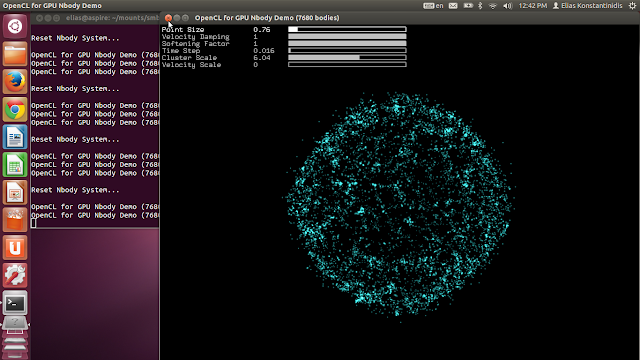
For the last I left the NVidia's nbody simulation (it was included in the CUDA SDKs prior to version 5). With a small modification it can run on AMD GPUs as well (and equally well).
Here is a screenshot:

NBody simulation on Ubuntu
NVidia's nbody sample OpenCL application on A6-1450
Press here for a larger screenshot.

The results are quite good. For a 16384 body benchmark (parameters: --qatest --n=16384)  the APU performed almost 50GFLOP/S (49.67). Let me note here that my 8600GTS did about the same!

On summary, the APU consists a nice mobile development platform for OpenCL applications which supports double precision maths with minimal power footprint.