Saturday, February 15, 2014

AMD Catalyst 14.1 and OpenCL SPIR

I recently noticed that the AMD Catalyst 14.1 BETA seemed to enable a very interesting extension. Look the extract of the clinfo command bellow executed on a HD-7750:


Number of platforms:     1
  Platform Profile:     FULL_PROFILE
  Platform Version:     OpenCL 1.2 AMD-APP (1411.4)
  Platform Name:     AMD Accelerated Parallel Processing
  Platform Vendor:     Advanced Micro Devices, Inc.
  Platform Extensions:     cl_khr_icd cl_amd_event_callback cl_amd_offline_devices cl_amd_hsa 


  Platform Name:     AMD Accelerated Parallel Processing
Number of devices:     2
  Device Type:      CL_DEVICE_TYPE_GPU
  Device ID:      4098
  Board name:      AMD Radeon HD 7700 Series   
  Device Topology:     PCI[ B#5, D#0, F#0 ]
  Max compute units:     8
  Max work items dimensions:    3
    Max work items[0]:     256
    Max work items[1]:     256
    Max work items[2]:     256
  Max work group size:     256
  Preferred vector width char:    4
  Preferred vector width short:    2
  Preferred vector width int:    1
  Preferred vector width long:    1
  Preferred vector width float:    1
  Preferred vector width double:   1
  Native vector width char:    4
  Native vector width short:    2
  Native vector width int:    1
  Native vector width long:    1
  Native vector width float:    1
  Native vector width double:    1
  Max clock frequency:     820Mhz
  Address bits:      32
  Max memory allocation:    685349273
  Image support:     Yes
  Max number of images read arguments:   128
  Max number of images write arguments:   8
  Max image 2D width:     16384
  Max image 2D height:     16384
  Max image 3D width:     2048
  Max image 3D height:     2048
  Max image 3D depth:     2048
  Max samplers within kernel:    16
  Max size of kernel argument:    1024
  Alignment (bits) of base address:   2048
  Minimum alignment (bytes) for any datatype:  128
  Single precision floating point capability
    Denorms:      No
    Quiet NaNs:      Yes
    Round to nearest even:    Yes
    Round to zero:     Yes
    Round to +ve and infinity:    Yes
    IEEE754-2008 fused multiply-add:   Yes
  Cache type:      Read/Write
  Cache line size:     64
  Cache size:      16384
  Global memory size:     802160640
  Constant buffer size:     65536
  Max number of constant args:    8
  Local memory type:     Scratchpad
  Local memory size:     32768
  Kernel Preferred work group size multiple:  64
  Error correction support:    0
  Unified memory for Host and Device:   0
  Profiling timer resolution:    1
  Device endianess:     Little
  Available:      Yes
  Compiler available:     Yes
  Execution capabilities:     
    Execute OpenCL kernels:    Yes
    Execute native function:    No
  Queue properties:     
    Out-of-Order:     No
    Profiling :      Yes
  Platform ID:      0xb7446660
  Name:       Capeverde
  Vendor:      Advanced Micro Devices, Inc.
  Device OpenCL C version:    OpenCL C 1.2 
  Driver version:     1411.4 (VM)
  Profile:      FULL_PROFILE
  Version:      OpenCL 1.2 AMD-APP (1411.4)
  Extensions:      cl_khr_fp64 cl_amd_fp64 cl_khr_global_int32_base_atomics cl_khr_global_int32_extended_atomics cl_khr_local_int32_base_atomics cl_khr_local_int32_extended_atomics cl_khr_int64_base_atomics cl_khr_int64_extended_atomics cl_khr_3d_image_writes cl_khr_byte_addressable_store cl_khr_gl_sharing cl_ext_atomic_counters_32 cl_amd_device_attribute_query cl_amd_vec3 cl_amd_printf cl_amd_media_ops cl_amd_media_ops2 cl_amd_popcnt cl_khr_image2d_from_buffer cl_khr_spir 

Just look at look at the last line of the supported extensions of the device. There is a magic word called cl_khr_spir! Does this mean that SPIR is already supported by the driver? I don't know and I haven't performed any tests yet. Unfortunately I don't have much time to do it now but if anyone does please let me know.


Tuesday, January 28, 2014

Benchmarking the capabilities of your OpenCL device with clpeak, etc.

In case you're interested in benchmarking the performance of your GPU/CPU with OpenCL you could try a simple program named clpeak. It's hosted on github: https://github.com/krrishnarraj/clpeak

For instance here is the output on the A4-1450 APU.
Platform: AMD Accelerated Parallel Processing
  Device: Kalindi
    Driver version : 1214.3 (VM) (Linux x64)
    Compute units  : 2

    Global memory bandwidth (GBPS)
      float   : 6.60
      float2  : 6.71
      float4  : 6.45
      float8  : 3.51
      float16 : 1.83

    Single-precision compute (GFLOPS)
      float   : 100.63
      float2  : 101.26
      float4  : 100.94
      float8  : 100.32
      float16 : 99.08

    Double-precision compute (GFLOPS)
      double   : 6.35
      double2  : 6.37
      double4  : 6.36
      double8  : 6.34
      double16 : 6.32

    Integer compute (GIOPS)
      int   : 20.33
      int2  : 20.39
      int4  : 20.36
      int8  : 20.33
      int16 : 20.32

    Transfer bandwidth (GBPS)
      enqueueWriteBuffer         : 1.80
      enqueueReadBuffer          : 1.98
      enqueueMapBuffer(for read) : 84.42
        memcpy from mapped ptr   : 1.81
      enqueueUnmap(after write)  : 54.32
        memcpy to mapped ptr     : 1.87

    Kernel launch latency : 138.08 us

  Device: AMD A6-1450 APU with Radeon(TM) HD Graphics
    Driver version : 1214.3 (sse2,avx) (Linux x64)
    Compute units  : 4

    Global memory bandwidth (GBPS)
      float   : 1.97
      float2  : 2.51
      float4  : 1.95
      float8  : 2.79
      float16 : 3.54

    Single-precision compute (GFLOPS)
      float   : 1.30
      float2  : 2.50
      float4  : 5.01
      float8  : 9.21
      float16 : 1.07

    Double-precision compute (GFLOPS)
      double   : 0.62
      double2  : 1.35
      double4  : 2.56
      double8  : 6.27
      double16 : 2.44

    Integer compute (GIOPS)
      int   : 1.60
      int2  : 1.22
      int4  : 4.70
      int8  : 8.08
      int16 : 7.91

    Transfer bandwidth (GBPS)
      enqueueWriteBuffer         : 2.67
      enqueueReadBuffer          : 2.03
      enqueueMapBuffer(for read) : 13489.22
        memcpy from mapped ptr   : 2.02
      enqueueUnmap(after write)  : 26446.84
        memcpy to mapped ptr     : 2.03

    Kernel launch latency : 32.74 us


P.S.
1) Some performance measures of the recently released Kaveri APU are provided on Anandtech:
http://www.anandtech.com/show/7711/floating-point-peak-performance-of-kaveri-and-other-recent-amd-and-intel-chips
2) If you are interested you can find the presentation of the Kaveri on Tech-Day in PDF format here:
http://www.pcmhz.com/media/2014/01-ianuarie/14/amd/AMD-Tech-Day-Kaveri.pdf
3) The Alpha 2 of Ubuntu 14.04 seems to resolve the shutdown problem of the Temash laptop (Acer Aspire v5 122p). It must be due to the 3.13 kernel update. So, I'm looking forward to the final Ubuntu 14.04 release.

Thursday, January 2, 2014

Compute performance with OpenCL on AMD A6-1450 (Temash APU)

Being interested about the modern low powered Kabini/Temash APUs from AMD I was searching the internet for information regarding its compute performance on its GPU. I couldn't find almost anything. Their GPU is supposed to be based on GCN architecture but no more information was available. In addition, the AMD's APP SDK documents are outdated and they do not include any information about this APU. In fact they do not even include any information about the Bonaire GPU (HD 7790 & R7 260X branded cards) which is even older. AMD should definitely change it's policy if they want to be taken seriously about GPU computing. I hope an updated reference guide will be released anytime soon covering all recently released GPUs/APUs (Kabini/Temash, Bonaire, Hawai) and what is about to be released (Kaveri APU).

So I recently I got access to a small form laptop based on the A6-1450 APU (Temash) and I would like to share some experience I had with it. After struggling for 1-2 days to install a Linux distro on it I managed to install the Ubuntu 12.04.3. I couldn't install a recent version (i.e. 13.10) as it needed to initiate a graphics mode and with the supplied kernel it was not possible to execute the installer. 12.04.3 installed ok and thereafter I was able to install the catalyst manually. As I already tested with the Ubuntu 14.04 Alpha 1 this seems to be fixed.

In theory this APU features a quad core Jaguar CPU and a 128 shader GPU (HD 8250) operating at 300MHz with an overclock capability (max 400MHz). Unfortunately, memory is clocked at 1066MHz though I hoped it would be 1333MHz.

As all released APUs this one also supports OpenCL. So, I'll provide some information here to anyone who is interested. First, here is a revealing output of the clinfo tool:

Number of platforms:     1
  Platform Profile:     FULL_PROFILE
  Platform Version:     OpenCL 1.2 AMD-APP (1214.3)
  Platform Name:     AMD Accelerated Parallel Processing
  Platform Vendor:     Advanced Micro Devices, Inc.
  Platform Extensions:     cl_khr_icd cl_amd_event_callback cl_amd_offline_devices


  Platform Name:     AMD Accelerated Parallel Processing
Number of devices:     2
  Device Type:      CL_DEVICE_TYPE_GPU
  Device ID:      4098
  Board name:      AMD Radeon HD 8250
  Device Topology:     PCI[ B#0, D#1, F#0 ]
  Max compute units:     2
  Max work items dimensions:    3
    Max work items[0]:     256
    Max work items[1]:     256
    Max work items[2]:     256
  Max work group size:     256
  Preferred vector width char:    4
  Preferred vector width short:    2
  Preferred vector width int:    1
  Preferred vector width long:    1
  Preferred vector width float:    1
  Preferred vector width double:   1
  Native vector width char:    4
  Native vector width short:    2
  Native vector width int:    1
  Native vector width long:    1
  Native vector width float:    1
  Native vector width double:    1
  Max clock frequency:     400Mhz
  Address bits:      32
  Max memory allocation:    136839168
  Image support:     Yes
  Max number of images read arguments:   128
  Max number of images write arguments:   8
  Max image 2D width:     16384
  Max image 2D height:     16384
  Max image 3D width:     2048
  Max image 3D height:     2048
  Max image 3D depth:     2048
  Max samplers within kernel:    16
  Max size of kernel argument:    1024
  Alignment (bits) of base address:   2048
  Minimum alignment (bytes) for any datatype:  128
  Single precision floating point capability
    Denorms:      No
    Quiet NaNs:      Yes
    Round to nearest even:    Yes
    Round to zero:     Yes
    Round to +ve and infinity:    Yes
    IEEE754-2008 fused multiply-add:   Yes
  Cache type:      Read/Write
  Cache line size:     64
  Cache size:      16384
  Global memory size:     370147328
  Constant buffer size:     65536
  Max number of constant args:    8
  Local memory type:     Scratchpad
  Local memory size:     32768
  Kernel Preferred work group size multiple:  64
  Error correction support:    0
  Unified memory for Host and Device:   1
  Profiling timer resolution:    1
  Device endianess:     Little
  Available:      Yes
  Compiler available:     Yes
  Execution capabilities:     
    Execute OpenCL kernels:    Yes
    Execute native function:    No
  Queue properties:     
    Out-of-Order:     No
    Profiling :      Yes
  Platform ID:      0x00007f1d93cc6fc0
  Name:       Kalindi
  Vendor:      Advanced Micro Devices, Inc.
  Device OpenCL C version:    OpenCL C 1.2 
  Driver version:     1214.3 (VM)
  Profile:      FULL_PROFILE
  Version:      OpenCL 1.2 AMD-APP (1214.3)
  Extensions:      cl_khr_fp64 cl_amd_fp64 cl_khr_global_int32_base_atomics cl_khr_global_int32_extended_atomics cl_khr_local_int32_base_atomics cl_khr_local_int32_extended_atomics cl_khr_int64_base_atomics cl_khr_int64_extended_atomics cl_khr_3d_image_writes cl_khr_byte_addressable_store cl_khr_gl_sharing cl_ext_atomic_counters_32 cl_amd_device_attribute_query cl_amd_vec3 cl_amd_printf cl_amd_media_ops cl_amd_media_ops2 cl_amd_popcnt cl_khr_image2d_from_buffer 


  Device Type:      CL_DEVICE_TYPE_CPU
  Device ID:      4098
  Board name:      
  Max compute units:     4
  Max work items dimensions:    3
    Max work items[0]:     1024
    Max work items[1]:     1024
    Max work items[2]:     1024
  Max work group size:     1024
  Preferred vector width char:    16
  Preferred vector width short:    8
  Preferred vector width int:    4
  Preferred vector width long:    2
  Preferred vector width float:    8
  Preferred vector width double:   4
  Native vector width char:    16
  Native vector width short:    8
  Native vector width int:    4
  Native vector width long:    2
  Native vector width float:    8
  Native vector width double:    4
  Max clock frequency:     600Mhz
  Address bits:      64
  Max memory allocation:    2147483648
  Image support:     Yes
  Max number of images read arguments:   128
  Max number of images write arguments:   8
  Max image 2D width:     8192
  Max image 2D height:     8192
  Max image 3D width:     2048
  Max image 3D height:     2048
  Max image 3D depth:     2048
  Max samplers within kernel:    16
  Max size of kernel argument:    4096
  Alignment (bits) of base address:   1024
  Minimum alignment (bytes) for any datatype:  128
  Single precision floating point capability
    Denorms:      Yes
    Quiet NaNs:      Yes
    Round to nearest even:    Yes
    Round to zero:     Yes
    Round to +ve and infinity:    Yes
    IEEE754-2008 fused multiply-add:   Yes
  Cache type:      Read/Write
  Cache line size:     64
  Cache size:      32768
  Global memory size:     5670133760
  Constant buffer size:     65536
  Max number of constant args:    8
  Local memory type:     Global
  Local memory size:     32768
  Kernel Preferred work group size multiple:  1
  Error correction support:    0
  Unified memory for Host and Device:   1
  Profiling timer resolution:    1
  Device endianess:     Little
  Available:      Yes
  Compiler available:     Yes
  Execution capabilities:     
    Execute OpenCL kernels:    Yes
    Execute native function:    Yes
  Queue properties:     
    Out-of-Order:     No
    Profiling :      Yes
  Platform ID:      0x00007f1d93cc6fc0
  Name:       AMD A6-1450 APU with Radeon(TM) HD Graphics
  Vendor:      AuthenticAMD
  Device OpenCL C version:    OpenCL C 1.2 
  Driver version:     1214.3 (sse2,avx)
  Profile:      FULL_PROFILE
  Version:      OpenCL 1.2 AMD-APP (1214.3)
  Extensions:      cl_khr_fp64 cl_amd_fp64 cl_khr_global_int32_base_atomics cl_khr_global_int32_extended_atomics cl_khr_local_int32_base_atomics cl_khr_local_int32_extended_atomics cl_khr_int64_base_atomics cl_khr_int64_extended_atomics cl_khr_3d_image_writes cl_khr_byte_addressable_store cl_khr_gl_sharing cl_ext_device_fission cl_amd_device_attribute_query cl_amd_vec3 cl_amd_printf cl_amd_media_ops cl_amd_media_ops2 cl_amd_popcnt 

It's good that double precision arithmetic is actually supported on this APU (the brazos APUs did not) and this is actually something I didn't know. I measured the raw performance using FlopsCL (http://olab.is.s.u-tokyo.ac.jp/~kamil.rocki/projects.html) and proved to be 91 GFLOPS on single precision and 6.4 GFLOPS on double precision (which I wasn't sure it supported) arithmetic. It's not the supercomputer you were looking for but think that the whole APU has just 8W TDP.

Next, I measured the effective bandwidth with a custom OpenCL application. This proved to reach near 7GB/sec. It's just ok.

For the last I left the NVidia's nbody simulation (it was included in the CUDA SDKs prior to version 5). With a small modification it can run on AMD GPUs as well (and equally well).
Here is a screenshot:
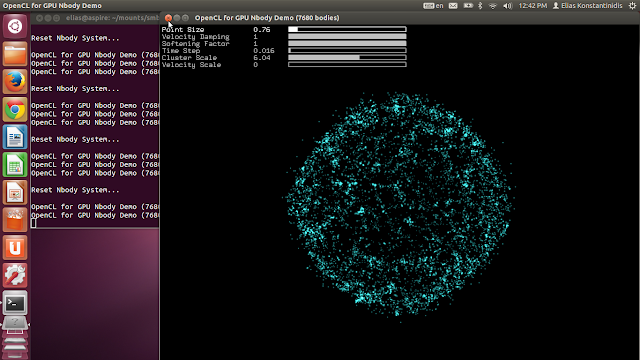
NBody simulation on Ubuntu
NVidia's nbody sample OpenCL application on A6-1450
Press here for a larger screenshot.

The results are quite good. For a 16384 body benchmark (parameters: --qatest --n=16384)  the APU performed almost 50GFLOP/S (49.67). Let me note here that my 8600GTS did about the same!

On summary, the APU consists a nice mobile development platform for OpenCL applications which supports double precision maths with minimal power footprint.

Saturday, December 14, 2013

A silly(?) prediction of a future CPU


First, let me warn you that what follows is not based on any recent scientific discovery but just on my imagination instead. As nowdays more and more computational units are fused within the CPU package the following picture could be some sort of a picture of a future chip.
As nowdays the CPU already incorporates GPU elements the following is a (rediculous) projection of a future central processing unit. It could contain a variety of combined cores for instance:
1) Serial compute cores (just like classic CPU cores)
2) Massively parallel cores (just like GPU compute units)
3) FPGA cores (for even more specialized tasks)
4) Quantum cores (???!! for NP-complete search problems?)

The last element is certainly not possible to be produced with current technology but in the future... who knows. It might turns to be just another component of the CPU package. How would it be called? QAPU?

Monday, November 4, 2013

More affordable scientific computing on GPUs

We have good news for affordable scientific computing on GPUs. Even though the AMD R9-290X made a step back by reducing double precision performance to 1/8 of single precision performance, this proved the R9-280X (with 1/4 dp to sp ratio) a true bargain for a ~1TFLOPS double precision performer for just $300. Furthermore, NVidia's upcomming GTX-780Ti GPU is rumored to have unlocked double precision units* turning it to a true number cruncher (more than 1.5 TFLOPS in dp compute) for a respectable $699, which is much less than GTX-Titan's price though.


Update: Unfortunately, it seems that the DP compute capability of GTX 780Ti is controversial. According to other information**, which seems valid, the DP potential is still limited to 1/24 of SP.  This proves the first link bellow inaccurate. Too bad for low budget researchers! 

Sources:
*: http://videocardz.com/47576/nvidia-geforce-gtx-780-ti-official-specifications
**: http://www.tomshardware.com/reviews/geforce-gtx-780-ti-review-benchmarks,3663.html#xtor=RSS-182

Wednesday, October 23, 2013

AMD "Hawai" compute performance extrapolation

Here is a graph of the theoretical peak performance of current top AMD GPUs. These include the Tahiti GPU known from the HD-7970 and the soon to be released Hawai GPU as the heart of the AMD R9-290X and R9-290. In this extrapolation each compute element in the GPU is supposed to perform 2 floating point operations per clock which is 1 MAD (multiply-add) operation per clock.


Each vendor will probably provide different cards operating in different frequencies so this diagram could be helpful for anybody who intends to by a new card for compute.

Wednesday, October 2, 2013

A note on the GPU programming paradigm

GPU programming employ a highly aggresive parallelism model. When someone endeavors to program GPUs has to exploit dual levels of parallelism. These are the coarse grained and fine grained parallelism models.


The coarse grained model is the one that allows scalability as it relies on the blocks of threads which have no way to synchronize together. Therefore, they are able to execute independently in parallel, feeding all the available compute units of the hardware device. If the programmer has specified enough of them in a kernel invocation they will keep the hardware highly utilized. It resembles programming the CPU at the thread level, although without any efficient option to synchronize multiple threads together.

Speaking about fine grained parallelism is like programming down to the SIMD level provided by the use of SSE or AVX instructions available on modern Intel & AMD x86 CPUs. However, programming is quite more flexible as using the so called SIMT (Singe Instruction Multiple Thread) model, in CUDA or OpenCL programming environments, one can program without even being aware of the SIMD nature. NVidia GPUs' SIMD width is 32 elements while AMD GPUs' width is 64 elements. Practically, the thread block size should be a multiple of this number, especially on NVidia GPUs, because memory access and pipeline latencies require a large number of threads on the compute unit in order to be hidden. At this parallelism level, threads are able to synchronize and communicate by exhanging data through the fast shared memory.

In this sense, GPUs employ parallelism to extreme levels. A modern GPU would require more than a thousand threads per compute unit to keep it utilized and it might consists of dozens of compute units.

GPU programming is both fascinating and dirty!