Tuesday, March 17, 2015

ISA reference guide for Volcanic Islands architecture

A new GPU ISA manual is available for AMD GCN 3rd generation GPUs. This is probably regarding the Tonga GPU and Carrizo APU as it mentions that context switching is an additional capability to the architecture.

You may download it here:

http://amd-dev.wpengine.netdna-cdn.com/wordpress/media/2013/07/AMD_GCN3_Instruction_Set_Architecture.pdf

Saturday, February 28, 2015

Maxwell for the masses (GM206)

As you probably already know the mainstream version of Maxwell GPU has already been released in the form of GM206. The graphics card bearing the chip is the GTX-960. The card seems to be pretty efficient and a significant improvement over Kepler especially in compute applications which is the one aspect that I'm particularly interested in. There has been some controversy of course due to its short memory bus (128bit) which entails a peak memory bandwidth of 112GB/sec. However, the larger cache memory should help alleviating this bottleneck.

The Zotac GTX-960 AMP! edition

In order to give you a taste about the compute capabilities of Maxwell I provide the results of experimenting with the OpenCL NBody example (16384 bodies) from the NVidia SDK 4.2 (the last one with OpenCL support). The GTX-960 yields a well above of 1TeraFlop performance which is impressive. I also performed executions with 3 more GPUs. All results are depicted in the chart that follows.


The red bars represent measured performance in GFLOPs and the green ones the efficiency as the ratio measured/peak GFLOPs performance.
The Maxwell architecture seems to address many issues with compute efficiency of its predecessor. However, there are two drawbacks. First, the low memory bandwidth as mentioned above and second, the quite low compute performance in double precision operations which is set now at 1/32 ratio with regard to single precision operations.
One last observation is the quite good performance of the AMD GPU although the example application had been developed by NVidia and it's reasonable to think that it is optimized for its own GPUs. This could be one of the main reasons that they stopped supporting the OpenCL paradigm.

Friday, February 13, 2015

Raspberry Pi 2 is here!


Well, it's here! Raspberry PI 2 looks very similar to it's predecessor, the Raspberry PI B+, except of two things. The rather old ARM11 core is upgraded to not one but four Cortex-A7 cores (900MHz). The Cortex-A7 is an upgrade by itself as benchmarks has shown that it is 1.5-3 times faster than the old CPU core. Four CPU cores do a decent upgrade for the same power envelope and the same price ($35). And this is not all of the changes. The new PI features double the amount of RAM which now reaches to 1GB.
To summarize it is a great upgrade of the old PI. I would say that it is the most affordable 4 core computer for applying parallel programming paradigms, e.g. OpenMP.
One can compare these nbench output to the original Raspberry PI nbench results. Keep in your mind that nbench is a single threaded benchmark.


BYTEmark* Native Mode Benchmark ver. 2 (10/95)
Index-split by Andrew D. Balsa (11/97)
Linux/Unix* port by Uwe F. Mayer (12/96,11/97)

TEST                : Iterations/sec.  : Old Index   : New Index
                    :                  : Pentium 90* : AMD K6/233*
--------------------:------------------:-------------:------------
NUMERIC SORT        :           453.9  :      11.64  :       3.82
STRING SORT         :          36.298  :      16.22  :       2.51
BITFIELD            :      1.1028e+08  :      18.92  :       3.95
FP EMULATION        :          82.381  :      39.53  :       9.12
FOURIER             :          4877.8  :       5.55  :       3.12
ASSIGNMENT          :          7.1713  :      27.29  :       7.08
IDEA                :          1364.7  :      20.87  :       6.20
HUFFMAN             :           663.8  :      18.41  :       5.88
NEURAL NET          :          5.7769  :       9.28  :       3.90
LU DECOMPOSITION    :          224.96  :      11.65  :       8.42
==========================ORIGINAL BYTEMARK RESULTS==========================
INTEGER INDEX       : 20.419
FLOATING-POINT INDEX: 8.434
Baseline (MSDOS*)   : Pentium* 90, 256 KB L2-cache, Watcom* compiler 10.0
==============================LINUX DATA BELOW===============================
CPU                 : 4 CPU ARMv7 Processor rev 5 (v7l)
L2 Cache            : 
OS                  : Linux 3.18.5-v7+
C compiler          : gcc-4.7
libc                : /lib/arm-linux-gnueabihf/libgcc_s.so.1
MEMORY INDEX        : 4.125
INTEGER INDEX       : 5.970
FLOATING-POINT INDEX: 4.678
Baseline (LINUX)    : AMD K6/233*, 512 KB L2-cache, gcc 2.7.2.3, libc-5.4.38
* Trademarks are property of their respective holder.

Saturday, December 20, 2014

Workgroup reduction function evaluation. How well do they perform?

The initial AMD driver for OpenCL 2.0 has already been released. The latest version of the OpenCL parallel programming API is quite interesting as it supports shared virtual memory, dynamic parallelism, pipes and other features. Among the rest of them are the workgroup and sub-workgroup functions which are abstractions that on one hand simplify parallel primitive operations such as broadcast, scan and reduction operations and provide the opportunity for the compiler for further optimizations on the other.

In order to evaluate the workgroup function performance I developed a test case experiment for a reduction of the sum 1+2+3+...+N. Reduction is implemented in 3 different ways with 3 kernels. The first kernel is performed in the classical manner with shared memory. The last performs the reduction with the workgroup reduction function. The intermediate kernel uses shared memory for the inter-wavefront stages and the subgroup reduction operation for the intra-wavefront stage.

The results seem somehow disappointing. The execution configuration is a 64bit Linux system, with an R7-260X GPU. The results are as follows:

Workgroup and sub-workgroup OpenCL 2.0 function evaluation test case
Platform/Device selection
Total platforms: 1
AMD Accelerated Parallel Processing
 1. Bonaire/Advanced Micro Devices, Inc.
 2. Intel(R) Pentium(R) 4 CPU 3.06GHz/GenuineIntel
Select device index: 
Device info
Platform:       AMD Accelerated Parallel Processing
Device:         Bonaire
Driver version: 1642.5 (VM)
OpenCL version: OpenCL 2.0 AMD-APP (1642.5)
Great! OpenCL 2.0 is supported :)
Building kernel with options "-cl-std=CL2.0 -cl-uniform-work-group-size -DK3 -DK2 -DWAVEFRONT_SIZE=64"

1. Shared memory only kernel
Executing...Done!
Output: 2147450880 / Time: 0.089481 msecs (0.732401 billion elements/second)
PASSED!

2. Hybrid kernel via subgroup functions
Executing...Done!
Output: 2147450880 / Time: 0.215851 msecs (0.303617 billion elements/second)
Relative speed-up to kernel 1: 0.41455
PASSED!

3. Workgroup function kernel
Executing...Done!
Output: 2147450880 / Time: 0.475408 msecs (0.137852 billion elements/second)
Relative speed-up to kernel 1: 0.188219
PASSED!

The kernel with the workgroup function seems to perform more than 5 times slower than using just shared memory. This should definitely not be the case in a performance oriented environment like OpenCL. The performance of workgroup functions should be at least the same as using shared memory. Otherwise the workgroup functions are not essentially useful.

Unfortunately, CodeXL version 1.6 does not support static analysing of OpenCL 2.0 kernels and therefore I cannot inspect the resulting assembly code produced for the workgroup functions. According to theory swizzle operations has to be leveraged in order to optimize such operations.

Test case download link on github:
https://github.com/ekondis/cl2-reduce-bench

In case you notice any different results please let me know.

Tuesday, December 9, 2014

AMD OpenCL 2.0 SDK is available (BETA)

Eventually, the AMD SDK for OpenCL 2.0 has been released in a beta form. There are many examples exhibiting the new features. There are new accompanying documentation files though they are not written from scratch. For instance, table 2.5 in the optimization guide refers to only HD 7xxx devices. It wouldn't be hard for AMD to add the respective tables for Rx 2xx devices. Overall, this is a significant step forward for the OpenCL 2.0 adoption.

The device driver supporting OpenCL 2.0 was also released today.

For more information and download:

Sunday, October 5, 2014

Least required GPU parallelism for kernel executions

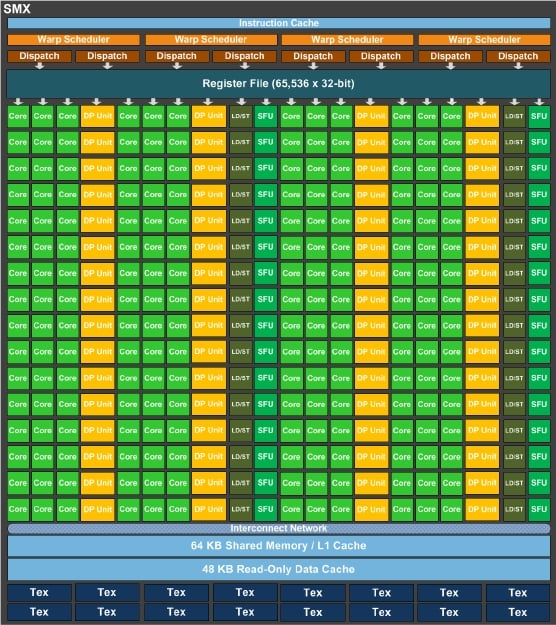
GPUs require a vast number of threads per kernel invocation in order to utilize all execution units. As a first thought one should spawn at least the same number of threads as the number of available shader units (or CUDA cores or Processor Elements). However, this is not enough. The type of scheduling should be taken into account. Scheduling in Compute Units is done by multiple schedulers which in effect restricts the group of shader units in which a thread can execute. For instance the Fermi SMs consist of 32 shader units but at least 64 threads are required because 2 schedulers are evident in which the first can schedule threads only on the first group of 16 shader units and the other on the rest group. Thus a greater number of threads is required. What about the rest GPUs? What is the minimum threading required in order to enable all shader units? The answer lies on schedulers of compute units for each GPU architecture.

NVidia Fermi GPUs


Each SM (Compute Unit) consists of 2 schedulers. Each scheduler handles 32 threads (WARP size), thus 2x32=64 threads are the minimum required per SM. For instance a GTX480 with 15 CUs requires at least 960 active threads.


NVidia Kepler GPUs

Each SM (Compute Unit) consists of 4 schedulers. Each scheduler handles 32 threads (WARP size), thus 4x32=128 threads are the minimum requirement per SM. A GTX660 with 8 CUs requires at least 1024 active threads.

In addition, more independent instructions are required in the instruction stream (instruction level parallelism) in order to utilize the extra 64 shaders of each CU (192 in total).


NVidia Maxwell GPUs

Same as Kepler. A GTX660 with 8 CUs requires at least 1024 active threads. A GTX980 with 16 CUs requires 2048 active threads.

The requirement for instruction independency does not apply here (only 128 threads per CU).


AMD GCN GPUs

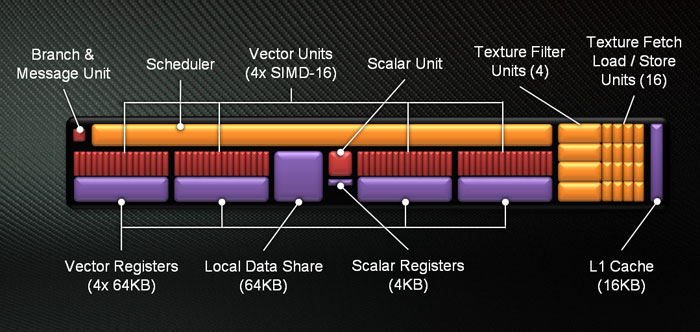
Regarding the AMD GCN units the requirement is more evident. This is because each scheduler handles threads in four groups, one for each SIMD unit. This is like having 4 schedulers per CU. Furthermore the unit of thread execution is done per 64 threads instead of 32. Therefore each CU requires the least of 4x64=256 threads. For instance a R9-280X with 32 CUs require a vast amount of 8192 threads! This fact justifies the reason for which in many research papers the AMD GPUs fail to stand against NVidia GPUs for small problem sizes where the amount of active threads is not enough.


Friday, May 23, 2014

IWOCL 2014 (International Workshop on OpenCL) presentations available online

Presentation files of the the IWOCL (International Workshop on OpenCL) 2014 are available for download.

URL:
http://iwocl.org/iwocl-2014/agenda-and-slides/


Note: The International Workshop on OpenCL (IWOCL) is an annual meeting of OpenCL users, researchers, developers and suppliers to share OpenCL best practise, and to promote the evolution and advancement of the OpenCL standard. The meeting is open to anyone who is interested in contributing to, and participating in the OpenCL community.